
Online Catalogue Printing
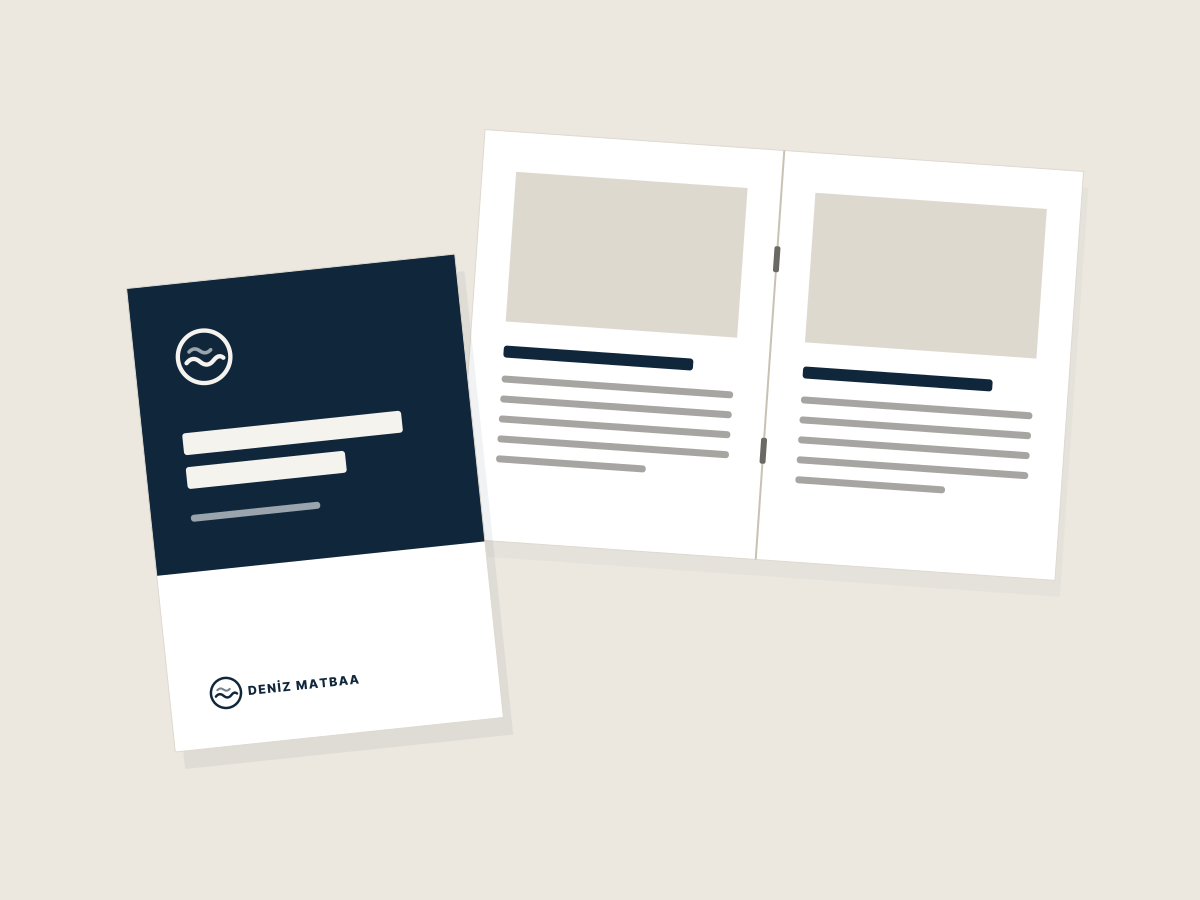
Design it free with AI
We automatically build a prompt for your Catalogues & Booklets that matches the size and print rules. Paste it into ChatGPT or Gemini, generate your image, upload it here — we print the rest.
- 1Pick your name, colours and style
- 2Copy the ready prompt into the AI
- 3Upload the image to your order
Why Deniz Dijital Matbaa?
Google rating 4.9 · 191 reviews- In Antalya since 1968, a family businessPrinting that began with Derya Matbaa (1968) and Deniz Matbaa (1991) continues today at our workshop in Muratpaşa.
- Digital printing in our own workshopKonica Minolta AccurioPress C12010S and C12000 as well as Konica Minolta C1085 digital printing, UV flatbed and 3.20 m eco-solvent printing; camera-guided cutting, a Polar guillotine, thermal lamination, folding and saddle stitching in the same workshop. Our full equipment list →
- Nothing printed without your approvalWe check every file for free before printing; free reprint if there is a production error.
“A friendly family business — my business cards and brochures were printed in 30 minutes in total. Very happy.”
“The stickers arrived without any problem. The print quality was much better than I expected.”
Quotes are translated from independent customer reviews on our Google Business Profile; names are omitted. About us →
Options for Catalogues & Booklets
Options and quantities available in express and standard production; prices include VAT and are shown in the site currency. The exact price for your selection is calculated in the order form.
| Option | Express production | Standard production |
|---|---|---|
| Pages | 8 pages 12 pages 16 pages 20 pages 24 pages 28 pages 32 pages 36 pages 40 pages 44 pages 48 pages | 8 pages 12 pages 16 pages 20 pages 24 pages 28 pages 32 pages 36 pages 40 pages 44 pages 48 pages |
| Cover | Self cover Thick cover | Self cover Thick cover |
| Quantities | 1 · 10 · 25 · 50 · 100 · 200 · 300 | 1 · 10 · 25 · 50 · 100 · 200 · 300 |
| Starting price (VAT incl.) | TRY 1,209 · 1 pcs | TRY 930 · 1 pcs |
| Production time | Produced in 1 working day | 5 business days |
Saddle stitch, perfect binding and spiral
- Saddle stitch: folded sheets are stapled at the spine; ideal for thin catalogues. Our online catalogue is saddle-stitched: 8–48 pages including the cover, from 1 copy.
- Page count in multiples of 4: each sheet is folded in the middle and makes 4 pages (8, 12, 16 … 48).
- Perfect binding: pages are glued at the spine for a flat spine and need enough thickness; by quote.
- Spiral: for catalogues that must lie open on a table; by quote.
- Heavy cover: 380 gsm, laminated both sides; the standard cover is the same coated paper as the inside pages.
Catalogue printing
We care about every detail that tells your product’s story
A good catalogue does more than collect product photos. It shows colours faithfully, makes information easy to read and, when you hold it, conveys the quality of your brand.
At Deniz Dijital Baskı Merkezi we plan your catalogue with you from the first idea to delivery. Size and page structure, paper, print file, colour assessment, cover, binding and final checks are not separate decisions — together they shape how the finished product looks.
Standard & custom sizes
A4, A5, landscape, portrait or custom size
Choose your catalogue size according to its content and where it will be used:
| Closed catalogue size | Dimensions | Suitable for |
|---|---|---|
| A4 portrait | 210 × 297 mm | Company profiles, detailed product information and proposal documents |
| A4 landscape | 297 × 210 mm | Wide product photos, architecture and image-led presentations |
| A5 portrait | 148 × 210 mm | Easy-to-carry product and service catalogues |
| A5 landscape | 210 × 148 mm | Compact, image-led presentations |
| Custom size | Per project | Designs that standard sizes don’t suit |
Closed size and binding allowance
These are the dimensions of the closed catalogue. The open spread size, bleed and the margin on the binding side are calculated separately when the file is prepared. Especially in landscape catalogues, it is important to check at design stage how wide photos cross the spread.
Size advice by use
If you are not sure which size suits you, tell us where the catalogue will be used. We may suggest different sizes for a presentation reviewed at a desk, a catalogue carried by a sales rep, or a publication handed out at a fair.
Paper & feel
Inner pages, cover and finish
Choosing paper is more than choosing a weight. It affects how photos look, how pages turn, how heavy the catalogue is and which binding is possible.
Inner page papers
For inner pages we consider coated or other papers depending on use. A thinner paper keeps a high page count light, while a firmer paper gives a short catalogue a different feel. The cover can use a heavier paper with a suitable finish.
Matte, gloss or soft-touch finish
We discuss options such as matte, gloss or velvety soft-touch according to the character of the design. The look you want on a dark, colour-rich cover and the durability a frequently used product catalogue needs may not be the same, so we recommend judging materials from physical samples rather than photos whenever possible.
Binding & durability
How can my catalogue be bound?
The binding method depends on the closed size, total page count, paper, how the catalogue should open and the budget.
Saddle stitch
Used for catalogues with a small to medium page count. Sheets are folded in the middle and stapled through the spine, so the total page count, including the cover, is planned in multiples of four.
Perfect binding
For thicker catalogues when a flat spine is wanted. The spine width is calculated once the page count and paper are final, and the cover is designed accordingly.
Spiral binding
For catalogues that are opened and closed often, that need to lie open on a desk, or that contain technical content.
Special binding & covers
Share your ideas for special folds, covers or assembly when the file is being prepared, and we’ll agree a workable method based on size, quantity and material.
A note for designers: don’t leave the binding decision until the design is finished. Text near the spine, images spanning a spread and the cover size are all affected by the binding method.
Careful colour management
How we work with colour
Colour accuracy in catalogue printing is not just a feature of one machine. How the photo was prepared, the file’s colour setup, the paper, the print settings and the final finish all affect the result.
Konica Minolta AccurioPress C12010S
IQ automatic colour control
The IQ technology on the Konica Minolta AccurioPress C12010S and C12000 controls colour automatically during printing; the C12010S also aligns the front and back sides. For projects where corporate colours or product photos are critical, we discuss expectations before printing. For suitable jobs you can check and approve a physical sample at our workshop.
A screenshot is not a print proof
Phones, monitors and paper show colour differently. The most reliable answer to “how will this red actually come out?” is a print sample on the chosen material.
Step by step
Catalogue production from file to delivery
We run every stage of your catalogue in a planned, transparent and controlled way.
We listen to your needs
We learn the catalogue’s purpose, audience, size, page count, quantity and how long it will be used.
We choose production options
We consider inner paper, cover, finish, binding and special applications such as white ink together.
We check the file
We check size, page order, image quality, text, bleed and trim areas. If we see anything that could affect production, we tell you before printing.
We assess colour and samples
For colour-critical jobs we clarify expectations and whether a physical sample is needed. Printing starts once design and production are approved.
We print and finish
After printing, trimming, folding, covering and binding are carried out according to the job plan.
We check and deliver
Once page order, overall appearance and finishing are checked, delivery or shipping is arranged.
Advanced technology
White ink and digital experience options
White ink printing
Some catalogues go beyond standard CMYK. On projects where the design and material suit it, we can use white ink. The areas to be printed white must be prepared separately in the file, and we assess the material and the expected look before production.
FAQ
Frequently asked questions about catalogue printing
Answers from size and colour to binding and file preparation.
Size and design
Should I choose A4 or A5?
If you show many product details, tables or large photos, A4 gives comfortable reading space. If you want a catalogue that is easy to carry and hand out, A5 may suit you. Decide together with the amount of content and how it will be used.
Can I print a landscape catalogue?
Yes. A4 and A5 catalogues can be landscape or portrait. Landscape suits wide images in particular. The binding edge and open spread size should be specified when preparing the file.
I want a non-standard size. Is that possible?
We consider custom sizes. The right production method depends on size, page structure, paper and quantity.
How is the page count calculated?
It depends on how the cover and inner pages are produced. In saddle stitching the pages come from folded sheets, so the count must be a multiple of four. We can work out a suitable page plan from your content.
Can one photo span two pages?
Yes, but if an important face, text or product detail sits in the middle of the spread, the result can vary with the binding. We check such images separately during the file check.
Paper, cover and binding
Can the cover and inner pages be different papers?
Yes. The cover and inner pages can use different papers or weights. We check how they open together and whether they suit the binding method.
Should I choose matte or gloss?
It depends on the design and use. Matte gives a calmer look; gloss can make some photos stand out. Seeing a physical sample before deciding is the most reliable way.
Can the catalogue have a soft-touch finish?
Yes, when it suits the project we can apply a velvety soft-touch finish. We decide where it is used and how it fits the design at the quotation stage.
Which binding is most durable?
No single method is best for every catalogue. Durability depends on page count, paper, frequency of use and binding. If we know how the catalogue will be used, we can advise more precisely.
Can a perfect-bound catalogue have spine text?
Yes, if the spine is thick enough. Don’t fix a spine width in the design until the final page count and paper are confirmed.
The catalogue will lie open on a desk. Which binding suits?
Tell us at the start of the order. We’ll consider options such as spiral binding or another structure that fits your project.
File preparation and colour
In what format should I send the catalogue file?
We prefer a print-ready PDF. The file should be at final size, with embedded fonts and images at sufficient resolution for print.
Should I leave bleed?
For backgrounds and images that run to the page edge we usually ask for at least 3 mm bleed. Keep text and important images inside the trim line. The safe margin on the binding side is set per project.
What resolution should images be?
300 DPI at final print size is a good target for photos. Enlarging a low-resolution image in the file does not bring back lost detail. We can check the images in your file before printing.
What happens if I send an RGB file?
RGB colours prepared for screens can shift when converted for print. If brand colours and product photos matter, we recommend reviewing the file together before printing.
Will the print match the screen exactly?
Screens and print reproduce colour differently, and the paper’s colour and surface also affect the look. For critical colours, approving a physical print sample is more reliable.
Can I see a sample before printing?
Depending on the project we can offer a sample. Just mention at the quotation stage that you would like to see a print sample at our workshop before deciding.
My file isn’t ready — can you help with design?
Yes. Based on your content, photos and the catalogue structure you want, we can scope the design work or the preparation of your existing file for print.
Quantity, special finishes and delivery
Can I print a small run of catalogues?
Yes. Digital printing makes short catalogue runs possible. The method and price depend on size, page count, materials and finishing.
Can I reprint the same catalogue later?
Yes. Before a reprint it is worth checking for changes to the file, product information or colour expectations. We approve the updated content before the new run.
Does white ink look the same on every paper?
No. The colour and surface of the base affect the result. If you are considering a catalogue with white ink, let’s review the material and design together.
Can you ship a catalogue to another city in Türkiye?
Yes. We plan production and shipping from Antalya for customers across Türkiye. Delivery time is confirmed at the quotation stage based on the job and approval date.
Related products
Used in these sectors: Restaurants & cafésReal estate agenciesHotels, guesthouses and tour agenciesTrade fair and congress exhibitorsLocal food producers and cooperativesSchools, courses and kindergartens